
Adiós Madrid, สวัสดีครับ Bangkok
On moving, finding home, setting roots
I’ve been in Bangkok for two weeks now— enjoying the delicious food, and mostly hiding from the humid heat in labyrinth-like malls, and I finally got some time to reflect on Madrid, moving, and starting anew in Bangkok.
Living abroad has taught me so much—not only about the culture of the host country—but about myself and what I want. It has profoundly reshaped my perceptions of culture, community, routine, and home. Some insights:
Living abroad makes you visualize culture
When staying in the place we grew up, we don’t give a second thought on attitudes and customs we’ve internalized, they feel common sense.
Culture is the water we swim in and living abroad makes you notice the water. You see schools of fish behaving differently. You notice the coral reef is a different color, the kelp forest is a different shape. You get the metaphor.
This is obvious in value systems or traditions. For example how Europeans value leisure more than Americans. How Japanese and Chinese value harmony and social cohesion more than individualism.
But culture is there in simpler, almost invisible ways too. A great example of culture’s grip is which side of the sidewalk we walk on. If you’re from the Americas or mainland Europe, you’ll notice something feels off with the photo.
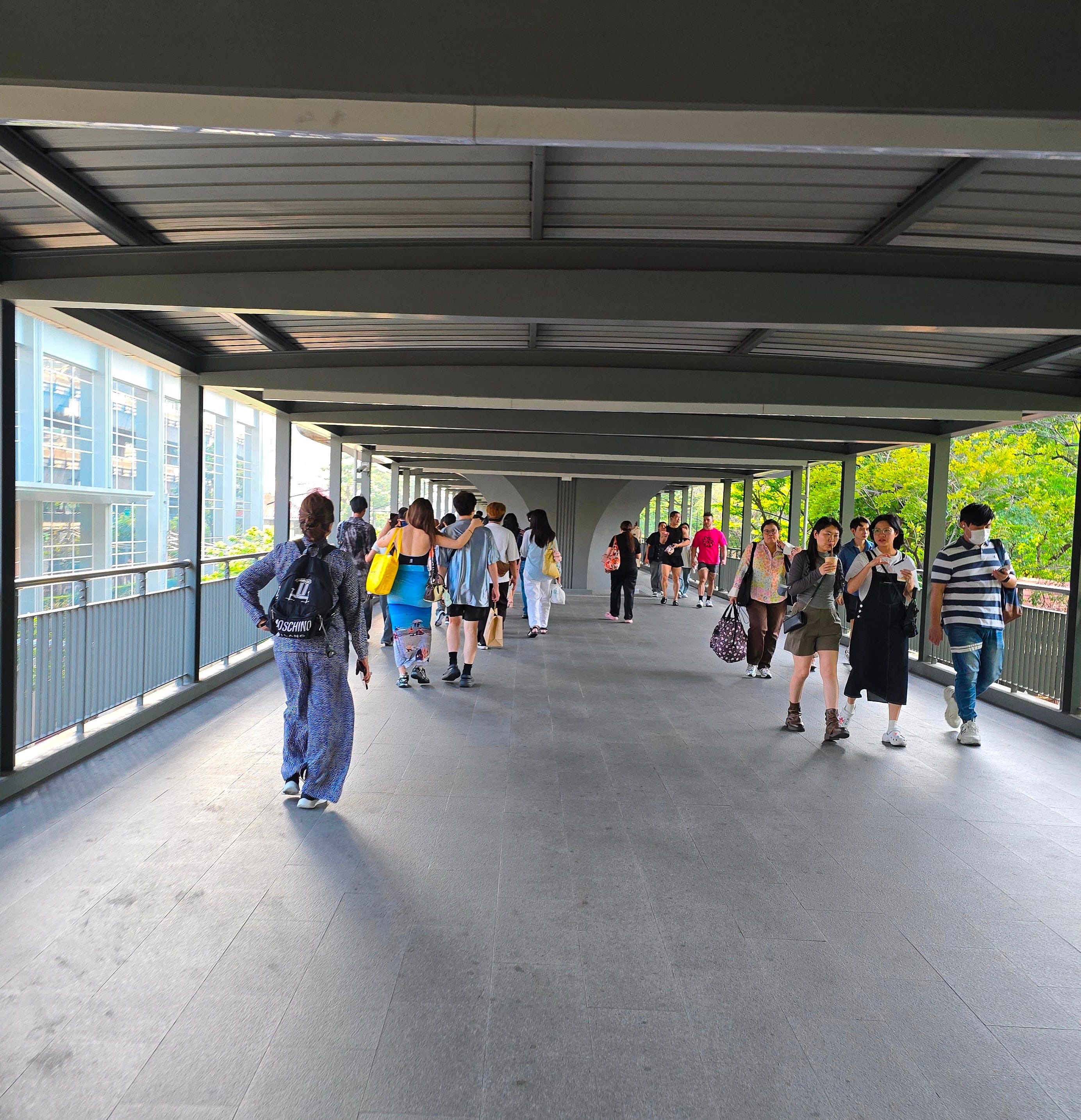
Well, it’s because we usually walk on the right side of a crowded street.
There are no rules for this, and it’s obviously more visible in a crowded walkway, but it’s there. A behavior determined by the most random of facts— apparently Britain instituted left-side driving in the 18th century (as in riding your horse—there were no cars yet), but Napoleon was a leftie so he preferred to ride his horse on the right side. So today most of the ex-British colonies (Japan and Thailand as well) drive on the left and the rest of the world on the right.
Constantly driving on one side internalizes that habit, and whenever we face foot traffic, we unconsciously choose the same side
I first noticed this when constantly bumping into fast Japanese commuters at crowded stations, where escalators and unconscious pathways are also left-sided. These subtle environmental influences are all around us but invisible until you notice them as a foreigner.
Culture shapes unconscious behaviors and complex visions of the world.
Stepping away from my own culture also made me see its grip. It helped me clearly define what I value in my life, independently of what’s expected, or considered “normal”
There is no perfect place
Get it out of your system. You can move endlessly but you won’t find a place that checks everything off your list.
Moi and I have an ongoing saying: “no le pidas peras al olmo” which literally translates to: "Don't ask the elm tree for pears”, meaning that one shouldn’t expect something from someone who can’t possibly provide it. In this case the someone is the city you’re living in.
Yes, it’d be amazing if Bangkok had kilometers and kilometers of walkable neighborhoods and cervecerías in wide open spaces like Madrid does, until I check the temperature for today and I’m reminded that it’s 36° C out, feels like 42°C and there’s 67% humidity. I’d rather stay indoors thank you very much.
And more often we want opposing things—like I want both a beautiful, historic place that feels innovative and modern. Madrid’s beauty comes precisely from its historic preservation, yet this very quality limits modern development.
Every choice comes with tradeoffs. Living abroad will help you crystallize what is absolutely important to you and what you’re willing to sacrifice.


Community is fundamental
After the novelty of a new city fades off, relationships define your quality of daily life.
Meaning I had to actively looked for friends in Madrid (and will do the same in Bangkok).
It’s such an overtly obvious effort that sometimes I felt like a teenager. “Hey want to hang out with me after the meetup”. Or whatsapping “I really liked our talk, want to get a coffee next week?” I had to get comfortable with being vulnerable and being direct about liking someone and getting to know them.
Luckily, we knew some people beforehand, and serendipity introduced us to wonderful neighbors.
Community might feel like a given in the place where you grew up, but in a new city, it isn't accidental—it’s actively cultivated. Meaningful connections require intention.


The importance of routines
A routine makes it feel like you’re actually living somewhere instead of just visiting.
When you travel, you usually go to new place or sights. Every day is about novelty and discovery. When you move somewhere, it’s about repetition. You go to a cafe or a market or a bakery, you like it, and you start going often, getting to know the vendors, your neighbors and you start feel like a local.
Routines are vital for mental, social, and physical health. That’s why we get so tired of traveling long term, we want to just do less each day.
Some routines we created in Madrid that worked wonders:
We instituted co-working lunches every Wednesday—where our neighbors and a few friends would eat with us and then we pretended to work but really we just hung out.
I attended a philosophy book cub semi-regularly and it became a source of intellectual camaraderie with people interested in the same niche books and essays, and I made really good friends.
And we hosted many cenas culturales, where different friends would give a presentation on a topic they were deeply interested in. We talked about permaculture, Spanish culture, crypto, free speech, and it was a great exercise in making “normal” moments (like a dinner party) more intentional (like this will be dinner party and this friend will discuss her love of poetry) which sparked so many wonderful conversations and explorations.
Routines transform a place into a home. When you imbue more meaning to a routine it becomes a tradition, a ritual. That’s when the magic happens.
The importance of breaking those routines
After the initial months of actively exploring the city and wandering into different neighborhoods you slowly reduce your area of action; you start sticking to the same neighborhoods you know. That offers the charm and comfort I was talking before, but it’s crucial to break them once in a while, to take advantage of where you are.
We all are creatures of habits and it’s crazy when you realize how little we venture out of our neighborhood—of our routines—on our day to day.
Trips to new cities, or with friends became invaluable. Living in Europe provided an incredible opportunity: weekends in London, Athens, Rome, or Paris were easy experiences. Not to say anything of road trips along Spain’s Pais Vasco, Galicia, or Andalucía.
Europe is such a microcosm of different cultures in a tight space. It’s around size of the US but has 700 million people and more than 40 countries.
Yet, this is applicable to every place you live in. Whether it’s Europe, the Americas or your hometown of 10,000 people. There's always something new to discover, regardless of how far away it is.


Towards a more nuanced definition of home
Living in a place where you feel comfortable is such a pleasure. And the more I move, the more attuned I am to what those things are.
Home is the accumulation, transport and care of precious clutter. You know, Moi’s Japanese knives, our favorite handmade mugs, heavy stainless steel pans, thrifted cutlery, reference books, and not one but two heavy brass “kenzan” (the spiky things where you stab flowers for Ikebana arrangements).
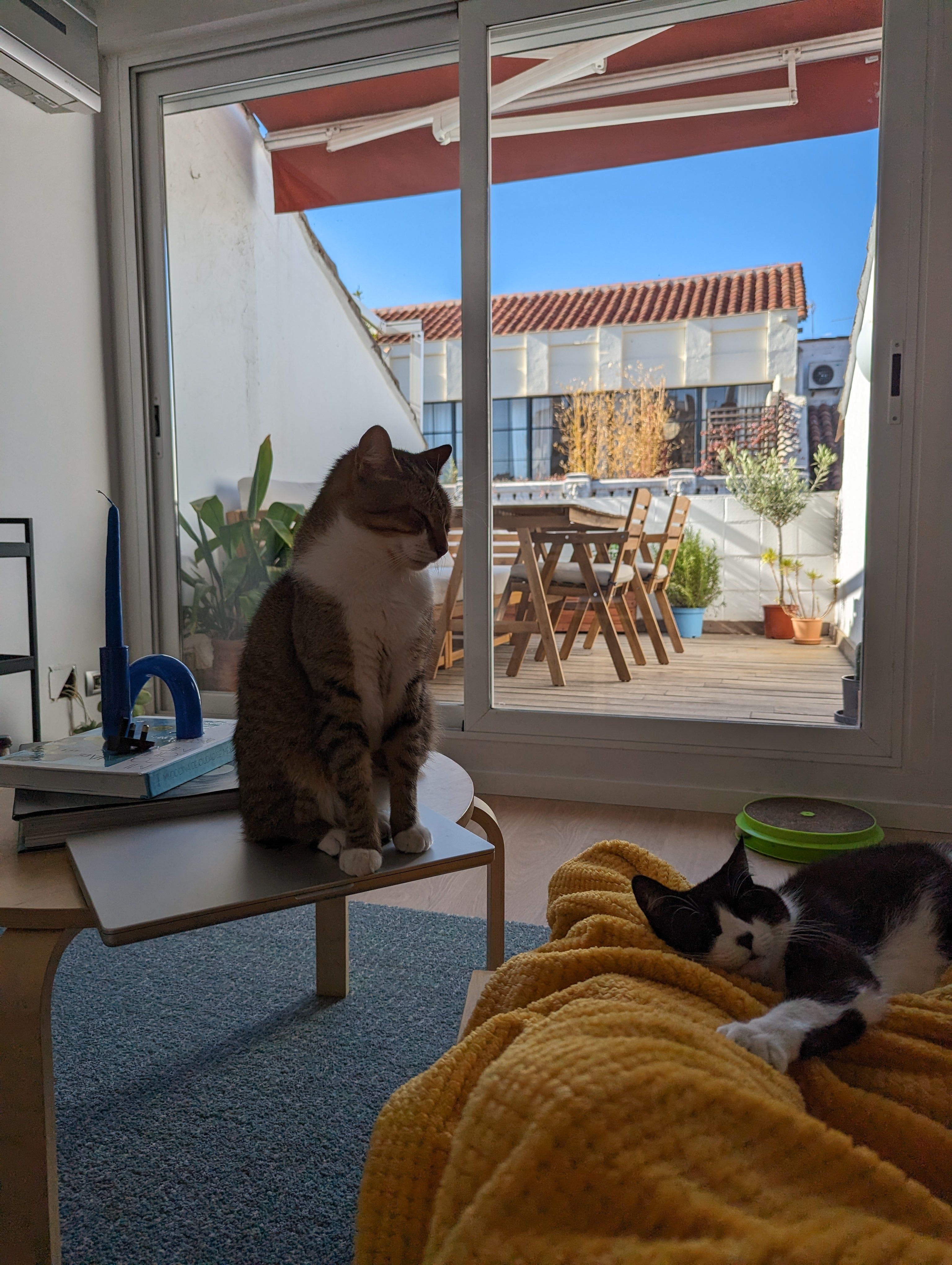
Things that are not clutter but valued members of our family, who are also fundamental in transforming a soulless place into a home are our very international cats who are always down to explore new cities as long as they have a constant supply of soft, cozy surfaces to sleep 16 hours a day.
Home is where Moi is. Sounds cliched, but it’s huge. I can pick up and move across the world to Bangkok because I have my best friend right there beside me. His presence turns empty apartments in new cities into places where I genuinely feel anchored. This is way bigger than moving. Having someone who supports you, respects you, wants to grow old with you provides an unshakeable foundation to take big risks, to screw up, and to go after the life you actually want.
Home is when I hang out with my family. When I meet my siblings, especially when abroad, something ancient kicks in. That deep connection, that unbreakable bond, the passage of time… It pulls me right back to my childhood—the raw, familiar warmth of home. It’s incredible to share my life with them.
Home is also feeling part of a larger community. The streets you constantly walk on, the characters that make the neighborhood, the friends you regularly meet, all of that will shape your experience of a place.
I don’t want to live in only one place, but I don’t want to be a “nomad”
The realization that home can transcend a single place was profound.
I want to lay roots in two or three places. Like snowbirds (people from cold places who travel to warm places during the winter), I want sustained, meaningful connection with a couple places I love and want to keep coming back to.
Once you’ve traveled enough, you realize humans everywhere share fundamental similarities. Travel first expands, then shrinks the world in beautiful ways.
Early travels emphasize difference. You see all the variety, the otherness of different cultures and geographies. After a while though, you start seeing the similarities. In the end, we’re all human beings trying to live a good life, provide for our family and—if possible—have a cold drink at the end of the day and talk to the people we love.
Gradually, those experiences reshape us—each interaction and location adds layers, creating a richer, more complex identity. Isn’t that amazing?
After all, I want to become a node connecting cool people doing cool stuff all over the world.
postscript 📮
Now that I’m going to be in Bangkok for a while, please share any recommendations on places, projects, people you love in Thailand or Asia!
Also, what have you learned from living abroad?
Muy cierto! Me encantó como lo describes San ❤️