
The Salieri Impulse
You're not rich enough (and other lies we tell ourselves)

I got some comments on my last post saying something along the lines of “well, this is cool but you can only do what you want if you have a lot of money” and “sure, but no one has that amount of freedom, we all have to work to pay our bills”.

First off—thank you for responding to my essays, this is why I do this! But I don’t want my perspective on agency to be understood as a superfluous take of “just be rich.” Let me clarify.
The glaring truth we all ignore is this: We have a limited amount of time on this miraculous little planet. Isn’t our most important task in life deciding what to actually do with it?
This might feel too big or self-indulgent, and maybe that's why people jumped to believing the question isn't for them because they're not rich enough or don't have any free time.
I’m asking the question to you, not a Saudi prince or a Manhattan neurosurgeon. You, with your exact bank account, your specific skills, and your particular insecurities. This is about your life.
We all have constraints but we have influence
The problem is thinking you can’t change anything because you can’t change all of it.
We need to take responsibility for the lot we were given. Yes, it’d be easier if you were born into a lot of money, or you had the most supportive family, but we can’t control that. Each of us plays the game of life with a different handicap. The first step is accepting the constraints we were born with. The second is accepting that we can influence them.
I’m not saying change them entirely, but each action you willingly take will affect the next one and so on. Your life will look very different depending on what you choose to do. I'm reminded of Wait But Why's diagram showing how each choice creates a branching path of possibilities.
When you realize that you are responsible for your life, for your time, for your actions, every decision counts.
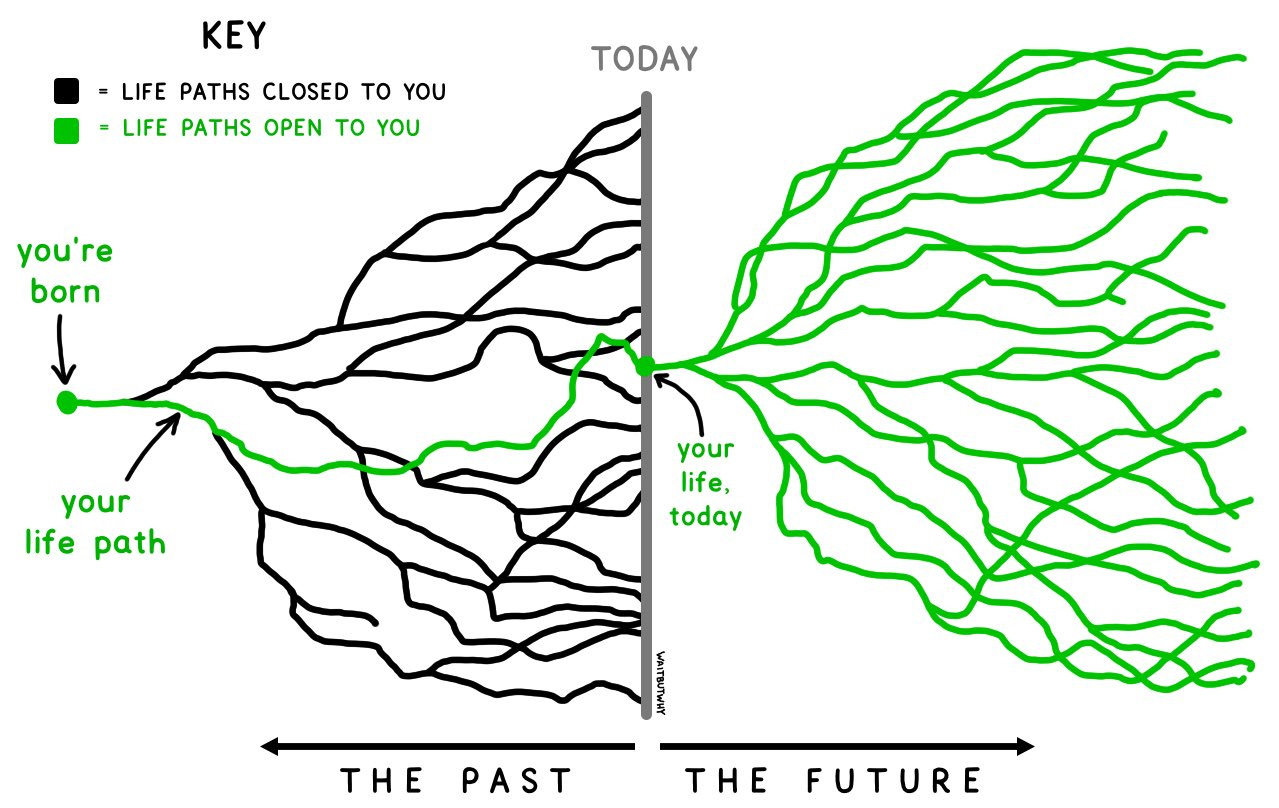
By doing what you want, I don't mean having unlimited freedom, I mean having the opportunity to choose what will eventually tie you down. We all choose stuff that limits our freedom: a job, a partner, having a kid, learning Japanese, giving up carbs. The paradox of commitment is that we feel freer—our days more intentional and purposeful—after consciously choosing what that ties us down..
Ask yourself if you’re where you’d like to be. What's the thing you keep postponing? Not the abstract dreams, but the specific changes you know you need to make. The conversations you're avoiding. The habit that's making you feel depleted or anxious. The decision you've been sitting on for months. Start there.
What matters is how you spend your ordinary days. In the end, your life is just a collection of Tuesdays and Thursdays. How conscious and intentional are you during them? Or are you just getting through them, hoping they are over quickly, waiting for your “real life” to start?
Stop being your own Salieri

Remember the movie Amadeus, about Mozart’s life? The movie is actually about Antonio Salieri, a more mediocre composer being driven mad with jealousy over Mozart's genius, secretly sabotaging him while being tortured by how amazing his music is.
We are all Salieri at one point.
We meet a “Mozart”. A person we know publishes a brilliant book, lands a dream job, or launches a cool start-up. Their success isn’t just impressive, it feels personal to us because we had a similar aspiration.
We slip into Salieri mode. We fixate on the other’s success and start comparing ourselves: Wow. But I work harder. I’m more talented. Why them? The inner dialogue turns from admiration to comparison to envy.
We conclude that it’s too late for us, that the whole game is rigged, that we actually didn’t want to do that. We defer the dream another month, another year, until it becomes a ghost in the attic. Envy is safer than action, and wallowing there we create more excuses of why it’s impossible for us to even try.
The postponement (or outright denial) of our aspirations slowly corrodes other dreams because we start believing the lie that we are not capable. Every new idea we have, or successful person we meet is met with an ever growing resentment.
The resentment, of course, is at ourselves. Deep down, we had the same impulse, we just didn't act on it. And that knowledge eats at us. We tell ourselves we weren't good enough to have what we wanted, even though we never actually tried. In your 20s you tell yourself you have time; in your 60s, the regret of missed opportunities becomes crushing.
The Salieri impulse thrives on the myth that genius (or success) is a zero-sum game. A co-worker’s success is not evidence of our inadequacy. A neighbor's wealth doesn't prevent us from growing our own income. A talented colleague's brilliance doesn't steal from our own—talent isn't rationed out in fixed portions.
The most important thing is self-trust. The decision to honor the aspirations we have and try our best to achieve them. Even if we don’t succeed, we were courageous enough to act. There’s no resentment there.
The sad fact is that we are our own Salieri to our own Mozart. Every impulse toward genius, toward out-of-the-box thinking, toward ambition—we sabotage it ourselves.
We can tell ourselves we’re not rich enough, not free enough, not talented enough, but life keeps pitching.
So let your inner Mozart go wild. Swing the bat. Miss spectacularly. Swing again.
I’m out of metaphors, but you get it.
Stop waiting.
postscript 📮
I’m back from China and have a lot to tell you, but first I wanted to add some nuance to my thinking.
Are there any Mozarts out there that you can change your relationship to?, i.e. Who in your life is living the career/relationship/lifestyle you secretly want? Have you ever asked them how they did it?
What’s the thing that you have been planning for a while but haven’t taken action?
It's a great idea to entirely ignore status and comparisons. Too bad most people spend their entire lives doing just until on their deathbeds they whine that they should have been authentic, worked less, wah wah wah.